

Somewhere in Johannesburg right now, a bride is reading this on her phone while her fiancé sits across the room insisting that he “doesn’t dance”. Or a groom is quietly googling because his partner has flatly refused to shuffle around a dance floor in front of her whole family. If that is you, take a breath: “my partner can’t dance” is the single most common thing we hear before a first lesson, and it has never once stopped a couple from having a first dance they were proud of.
This guide is for the reluctant half of the couple as much as the keen one. We will explain why “two left feet” is not actually the problem, what is really behind the refusal, how to get a nervous partner to agree to one lesson, and exactly what happens when they walk into our studio in Gallo Manor, Sandton.
“I can’t dance” usually means something else
After hundreds of first lessons, we have learnt that very few people are actually saying they lack the ability to move in time to music. When a partner digs in their heels, it is almost always one of these:
“I don’t want to look stupid.” This is the big one, and it is completely reasonable. The image in their head is a group dance class, a mirror, and strangers watching them get it wrong. None of that is how private wedding dance lessons work, which we will come back to.
“I don’t want to be the centre of attention.” Many people who hate dancing are perfectly happy to dance at a party where nobody is looking. The fear is specifically about the spotlight. The irony is that a planned routine is the cure for this, not the cause: knowing exactly what to do with your hands and feet is what makes you look – and feel – relaxed when everyone is watching.
“I have no rhythm.” Occasionally true in the sense that someone has never had to count music before. Never true in the sense that it cannot be learnt. Counting a song is a skill like any other, and we teach it in the first ten minutes.
“It’s one more thing on the list.” Wedding planning is exhausting, and a reluctant partner may simply be protecting their Tuesday evenings. Fair enough – but this is the one wedding task that is actually fun, and the only one you do together rather than in a spreadsheet.
Once you know which of these you are dealing with, you can answer the real objection instead of arguing about ability.
What a first dance actually is (and isn’t)
Here is the thing nobody tells reluctant partners: a first dance is not “dancing” in the way they are imagining it. Nobody is asking them to improvise to a beat in front of 120 people. A choreographed first dance is closer to walking a planned route – you learn a hold, a handful of steps that repeat, where to be at the chorus, and how to finish. Then you practise it until it is automatic. That is a completely different skill from being a “natural dancer”, and it is one that engineers, accountants and people who have never set foot on a dance floor pick up every week in our studio.
It also does not have to be elaborate. Our Basic package exists precisely for couples who want something clean, elegant and simple – an entrance, one or two nice moments and a proper ending. No lifts, no spins unless you want them, nothing that risks a wobble.
Why the alternative is actually worse
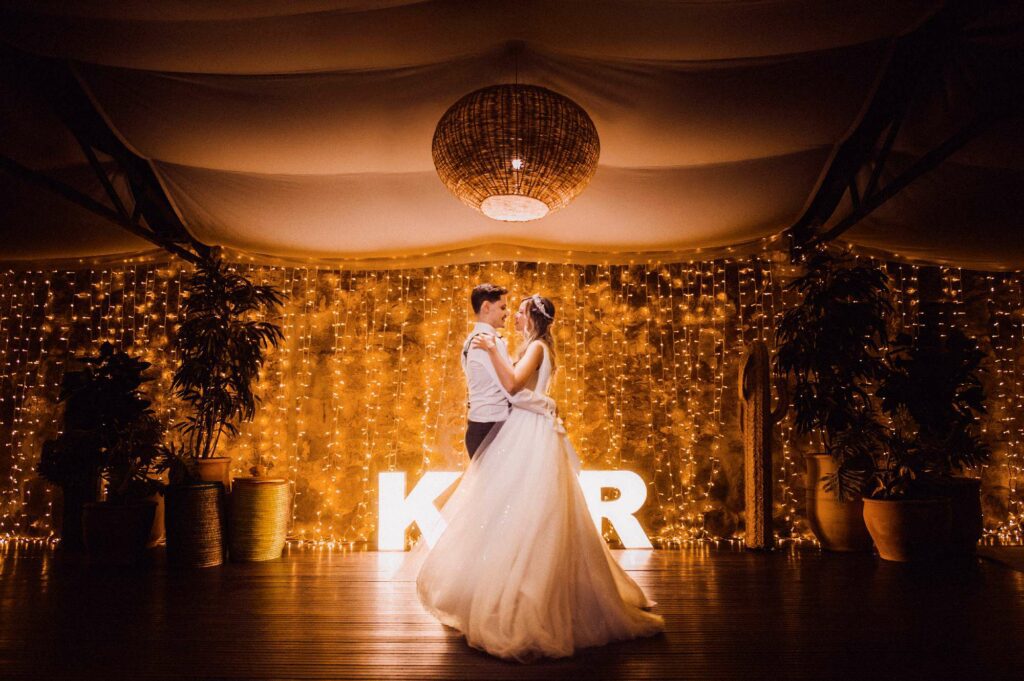
Reluctant partners tend to assume that skipping lessons means less pressure. In our experience it is the opposite. Without a plan, you walk onto the floor with no idea what to do, you rock from side to side for three and a half minutes (which is a very long time when you are counting the seconds), you have nowhere to put your hands, and you never know when it is over. That is the awkward scenario they are trying to avoid – and it is what happens without lessons, not with them.
Compare that with a couple who have done six sessions: they know when to walk on, they have a comfortable hold, the routine has a clear shape, and the song has been edited to two and a half minutes so it ends on a high. The photos show a dip or a spin instead of two people staring at their feet. The whole thing feels shorter, safer and far more like a moment than an ordeal.
How to get your partner to say yes
You will not win this by insisting. Here is what actually works, based on the couples who walked in with one very reluctant half and walked out as converts.
- Ask for one lesson, not a package. “Come to one session with me and if you hate it we’ll drop it” is a far easier yes than committing to ten weeks. In reality, almost nobody drops it after the first lesson – but the offer has to be real.
- Tell them it is private. This single fact dissolves most of the fear. No class, no mirror full of strangers, no other couples. Just the two of you and one instructor whose entire job is to make you look good.
- Let them choose the song. Ownership changes everything. A groom dancing to a track he picked is a very different person from one dancing to a song he was told about.
- Let them set the ambition. If they want simple, promise simple. You can always add a surprise element later once they are comfortable – and they often ask for it themselves.
- Frame it as a weekly date. An hour together, away from seating plans and family WhatsApp groups, followed by dinner. Most couples tell us the lesson became the highlight of their week.
- Show them this page. Sometimes it lands better coming from the people who do this every day than from the person they are marrying.
Book a single private session, bring your song, and see how it feels before committing to a package. No pressure, no audience.
Book a first lesson
What really happens in the first lesson
For the nervous partner reading this, here is an honest account of the first hour, so there are no surprises.
You arrive at our studio at 101 Bowling Avenue, Gallo Manor. It is just the two of you and your instructor. There is no warm-up routine to copy and no stretching in a line. We start by chatting about your song, your venue and your dress, and about what you each want the dance to be – including, very directly, what you do not want to do.
Then we put the song on and work out the beat together. This is the bit people dread and it takes about ten minutes. Once you can hear the count, we teach a basic hold – where the hands go, how close you stand, who leads – and a simple step that moves you across the floor in time. By the end of the first session most couples can travel across the room to their own song without thinking about it, and nearly all of them say some version of “oh, that was fine”.
Nothing is performed. Nothing is filmed unless you ask us to. And you leave with something small to practise in the lounge, which is where the confidence really builds.
“The dance was a surprise to everyone – even us!” – Leon and Naledi, who booked after Leon spent a month insisting he could not dance.
The easiest first dances for non-dancers
If your partner’s main condition is “keep it simple”, these are the styles we reach for first, because they rely on a small number of repeating steps and a clear lead.
| Style | Why it works for beginners | Suits |
|---|---|---|
| Slow waltz | One repeating box step, a comfortable hold and an obvious count. The less confident partner always knows what comes next. | Classic ballads and slower love songs. |
| Rumba | Small steps, no travelling required, and it looks romantic even when danced very simply. | Mid-tempo pop, R&B and acoustic songs. |
| Foxtrot (simplified) | Walks and side steps that feel natural, with a smooth, relaxed look. | Jazz standards, swing and older classics. |
| Simple contemporary | Less about formal footwork, more about a few shaped moments – a turn, a dip, a hold – linked by easy walking. | Modern pop and songs with a strong emotional build. |
Whatever the style, we edit the song down to around two to two and a half minutes. Less song means less to remember and a stronger finish, and for a nervous dancer it is the single most reassuring change we can make. If you are still deciding on music, our complete guide to wedding dance lessons has more on choosing a song that is easy to dance to.

A note for reluctant brides
It is not always the groom. Plenty of brides are the nervous half – often because the dress adds a layer of worry (will I trip, can I turn, what about the train?) or because they feel the spotlight more acutely. All of the above applies, with one addition: tell us about the dress at the first lesson. We choreograph around it, and if possible we rehearse in a practice skirt so that nothing on the day feels new. For brides who would rather not be spun or dipped at all, we simply do not include it. The dance is yours.
When the reluctant one becomes the keen one
We would be lying if we said this happens every time, but it happens far more often than you would expect. The partner who had to be dragged to lesson one is frequently the one asking, by lesson four, whether they could add a spin, or whether a surprise section into a faster song is “too much”. It turns out that the fear was never about dancing. It was about not knowing what to do – and once that is solved, the whole thing becomes fun.
Frequently asked questions
What if my partner really can’t dance?
Almost nobody can dance before their first lesson – that is the point of lessons. A first dance is not freestyle; it is a short, repeatable routine taught step by step and built around what your partner can comfortably do. Rhythm, timing and confidence are all teachable in six to ten private sessions.
How do I convince my fiancé to take wedding dance lessons?
Reframe it: lessons are private, there is no audience and no group class, and the routine is designed so nobody looks silly. Agree to try one lesson with no commitment, let them choose the song, and make it a weekly date rather than a chore. Most reluctant partners relax within the first twenty minutes.
Are the lessons private or in a group?
Every lesson at First Wedding Dance is private – just the two of you and your instructor in our Sandton studio. There are no group classes, no other couples watching and no fixed syllabus.
What is the easiest first dance for people who can’t dance?
A slow waltz or a simple rumba to a mid-tempo song. Both use a small number of repeating steps, a comfortable hold and clear leading, so the less confident partner always knows what comes next. We edit the song to around two to two and a half minutes so there is less to remember.
Can we do a simple first dance instead of a choreographed one?
Yes. Our Basic 6 session package is designed for exactly this – a clean, elegant routine with an entrance, one or two highlights and a proper finish, without lifts or tricks. It is far more comfortable than an unplanned sway because you always know what to do next.
What happens in the first lesson?
The first session is about getting comfortable: a basic hold, how to move together to the beat, and a feel for the style that suits your song. There is nothing to perform and nothing to get wrong. Most couples leave surprised at how much they can already do.
Ready to prove them wrong (gently)?
Bring your reluctant partner to one private lesson at our studio in Gallo Manor, Sandton, and let us take it from there. If they want simple, we will keep it simple; if they discover they love it, we have the Deluxe and Prestige packages waiting. Have a look at the gallery – every couple in it started somewhere – and then book your first lesson. You can also call us on 082 557 4473, email info@firstweddingdance.co.za, or see recent first dances on Instagram and Facebook.
No experience needed. No audience. A routine built around what you can do.
Book now